
Long-Term Partnership FAQ: Acceptance, Commissioning and Support for Digital Label Printers
Most of the questions that decide whether a digital label printer becomes a five-year production asset are asked after the quotation arrives, not before. By then the buyer already knows the print width, the ink set and the speed band. What is still open is how the press will be accepted, what the floor and the power supply must look like on the day the crate is opened, who trains the operators, how the printheads are kept healthy, and how a machine bought for short-run cosmetic labels grows into film labels and varnished work without replacing the platform.

GR350S digital label printer at Labelexpo Asia, where acceptance, commissioning and support terms are typically discussed with label printing factories and packaging converters.
This FAQ answers those post-quotation questions for the GR350S, the roll-to-roll UV inkjet digital label printer manufactured by Nanjing Grando Digital Technology Co., Ltd. (Grandoprint), a digital inkjet equipment manufacturer founded in 2010 with production and R&D bases in Nanjing and Shanghai. Every technical value below comes from the GR350S content units. The article intentionally does not state service-level response hours, warranty extensions or certification numbers that the manufacturer's published material does not confirm; where a term must be negotiated, the text says so instead of inventing it.
The short answer, in four lines
- Site: three-phase 380VAC, 50/60 Hz supply with approximately 10 kW power consumption; clean, dry compressed air at 0.6–0.8 MPa; 18–32°C ambient and 40–60% humidity; dust-free workshop.
- Space and media: 2850 (W) × 1400 (D) × 2040 (H) mm footprint; media width 120–360 mm; printing width 110–350 mm; unwinding diameter up to 700 mm.
- Acceptance: 100% functional testing before delivery, inline sensor/vision inspection and a CIS-based high-resolution real-time defect detection system; on-site installation, commissioning and trial operation after delivery.
- Support: operator training on operation and routine maintenance, telephone/remote and on-site technical support, remote monitoring with fault warning, original spare parts supply, localized service, software and hardware upgrade paths. Warranty is usually one year, subject to contract terms.
Problem definition: why post-quotation questions stall digital label printer projects
A request for quotation compares what is written on a datasheet. Commissioning compares what is physically on the floor. The gap between the two is where multi-year supplier relationships are usually won or lost, and it is rarely a machine-performance problem.
Three patterns repeat across label printing factories and packaging converters evaluating an industrial digital label printer:
- Acceptance criteria written after delivery. The buyer tested a few printed samples during evaluation, but the contract never defined which substrate, which file, which speed and which defect threshold would trigger sign-off. Disputes then hinge on opinion rather than specification.
- Site utilities discovered late. A three-phase 380VAC supply, roughly 10 kW of consumption, clean dry air at 0.6–0.8 MPa and a dust-free workshop are ordinary requirements for UV inkjet equipment, but they are usually absent from a quotation sheet. When they surface during installation, the schedule moves instead of the machine.
- Module decisions postponed. Pre-coating, corona treatment and post-coating varnish are optional on the GR350S. Buyers who plan to add premium finishes later often assume the decision can be deferred without consequence; lead time is tied to configuration, so the roadmap should be visible at order stage.
In some markets, micro-batch work already represents roughly 15–25% of label orders, according to Grandoprint's application notes for label printing factories. A press that is expected to handle that mix from month one needs an acceptance protocol and a support schedule, not only a speed figure.
Industry background: what has changed since the last press purchase
Label demand has moved toward shorter runs, more SKUs and more variable data, which changes what a buyer needs from a supplier after the sale. The Business Research Company's 2026–2030 digital label printer report values the global digital label printer market at USD 9.86 billion in 2026 and projects a 6.4% CAGR for 2025–2030; Custom Market Insights estimates UV inkjet at about 45% of digital label press technology in 2025. Both figures describe equipment demand and technology mix, not the performance of any individual machine, but they explain why converters keep adding digital capacity rather than extending conventional plate-based lines.
The application spread inside a single factory explains the support question better than any market number. Grandoprint's application material for label printing factories lists e-bike and new-energy decals, food and pharmaceutical colour labels, daily chemical and industrial labels printed with eco-friendly UV inks, garment accessories such as wash care labels and hang tags (resistant to 150 industrial washing cycles), tickets and anti-counterfeit labels with variable QR codes and invisible fluorescent ink, high-end cultural and brand-protection labels, and small-to-medium batch proofing. One press is therefore expected to serve several product families, each with its own substrate behaviour and its own definition of a good print.
That is the operating reality behind a long-term partnership agreement: the machine is bought once, but the configurations, substrates and job mix change repeatedly. The relationship has to be structured so those changes are routine rather than renegotiated.
Detailed solution: the four-part agreement behind a long-term digital label printer partnership
A workable multi-year relationship rests on four documents settled before the purchase order: a configuration and terms sheet, a site readiness checklist, an acceptance protocol, and a support schedule. Each one maps to facts the manufacturer publishes, and each one is cheap to write before shipment and expensive to improvise afterwards.
1. Commercial and configuration terms to fix before the purchase order
Grandoprint's OEM capability covers printhead configuration, ink configuration, voltage standard, software language, machine branding, spare parts package and selected functional modules, confirmed according to model configuration and customer requirements. Voltage standard is on that list, which is precisely why the destination grid — three-phase 380VAC, 50/60 Hz for the standard GR350S specification — should be confirmed in writing at this stage rather than discovered at installation.
Three commercial parameters are published and can be written directly into the agreement: a minimum order quantity of 1 unit, monthly capacity of 100 units, and a lead time of around 60 days after order confirmation, depending on machine configuration, order quantity, testing requirements and production schedule. Warranty is stated as usually one year, subject to contract terms. Because the wording is conditional, the contract should define what the warranty covers and how a claim is raised; the manufacturer's own material does not publish a response-time table, so a buyer who needs one should negotiate it explicitly instead of assuming it.
The fourth term is the acceptance definition: whose substrate, which artwork, which variable-data file, which speed within the 20–100 m/min band, and what constitutes a pass. That single paragraph prevents most installation disputes.
2. Site conditions: the numbers that decide whether commissioning runs to plan
The GR350S is specified for a temperature range of 18–32°C, humidity of 40–60%, and a dust-free workshop. Grandoprint's application notes explain why each number exists: low humidity may cause static electricity, high humidity can affect ink droplet placement accuracy, and dust can affect printhead precision. Ink storage is a separate requirement, maintained at 16–32°C with constant temperature control.
- Power supply: three-phase 380VAC, 50/60 Hz, with power consumption of approximately 10 kW.
- Air supply: 0.6–0.8 MPa, clean and dry compressed air for the pneumatic components.
- Cleanliness: dust-free workshop conditions to protect printhead precision.
- Footprint: 2850 (W) × 1400 (D) × 2040 (H) mm, with roll handling planned around an unwinding diameter of up to 700 mm.
- Supporting equipment: a corona treatment unit, a material cleaning unit to remove dust from the material surface, and — in plants that still run conventional plates alongside digital — a fully automatic plate-making system used in coordination with the traditional equipment.
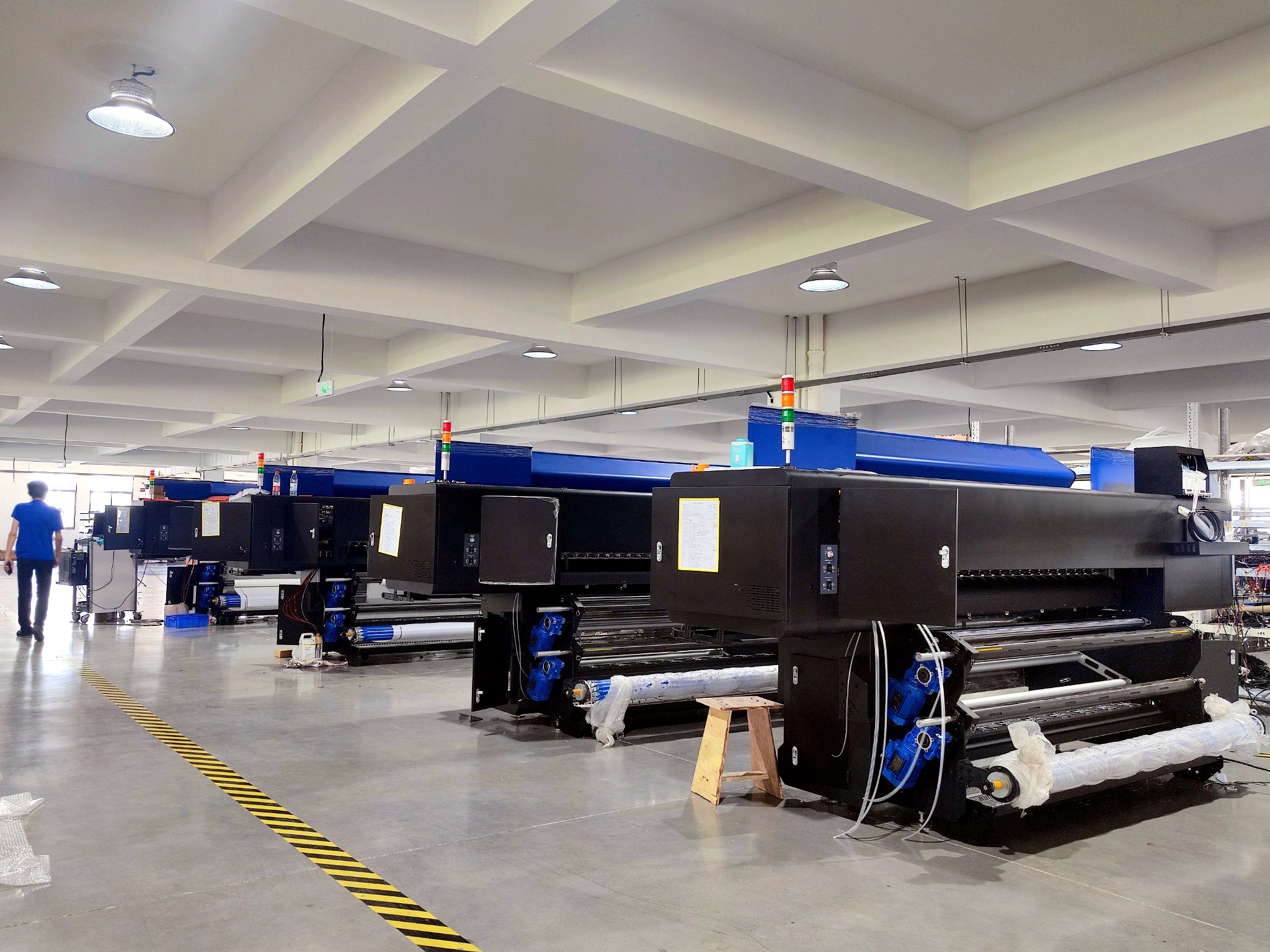
Assembly and testing line: functional testing happens before shipment, which is why the site checklist and the acceptance protocol should be agreed in parallel.
For a label printing factory, the practical implication is that two departments own different halves of the project. Facilities owns power, air, temperature, humidity and floor space; production owns the acceptance print. When the two are sequenced in the wrong order, a machine that passed every factory test can still sit idle for a week.
3. Acceptance: what to test at the factory and repeat on site
Quality control on the GR350S is described in three layers: inline inspection through sensors and vision systems monitoring defects, web breaks and roll diameter in real time; a professional CIS-based high-resolution real-time defect detection system; and 100% functional testing before delivery. Those are manufacturer-side checks. The buyer's acceptance protocol should add the application-side checks that only the buyer can define.
A practical acceptance list, built from published specifications, covers: printing speed across the band the buyer actually intends to run between 20 and 100 m/min; printing width from 110 to 350 mm and media width from 120 to 360 mm on real stock; label sensor mark tracking; intelligent deviation correction across a full roll; variable data printed directly from a database without batch PDF conversion; QR code and barcode readability and data accuracy; white ink and varnish if those options are configured; and ink adhesion on PE, PET, BOPP, PP and OPP films after corona treatment or pre-coating.
Grandoprint's own application guidance supports that last point: PET, BOPP, PVC, PP, PE, OPP films and synthetic label materials should be tested before batch production, and some difficult-to-print materials may require corona treatment or another surface treatment to improve UV ink adhesion. Heat-sensitive films need appropriate UV curing settings and temperature control to reduce deformation or discoloration. Acceptance without a film trial is therefore a partial acceptance.
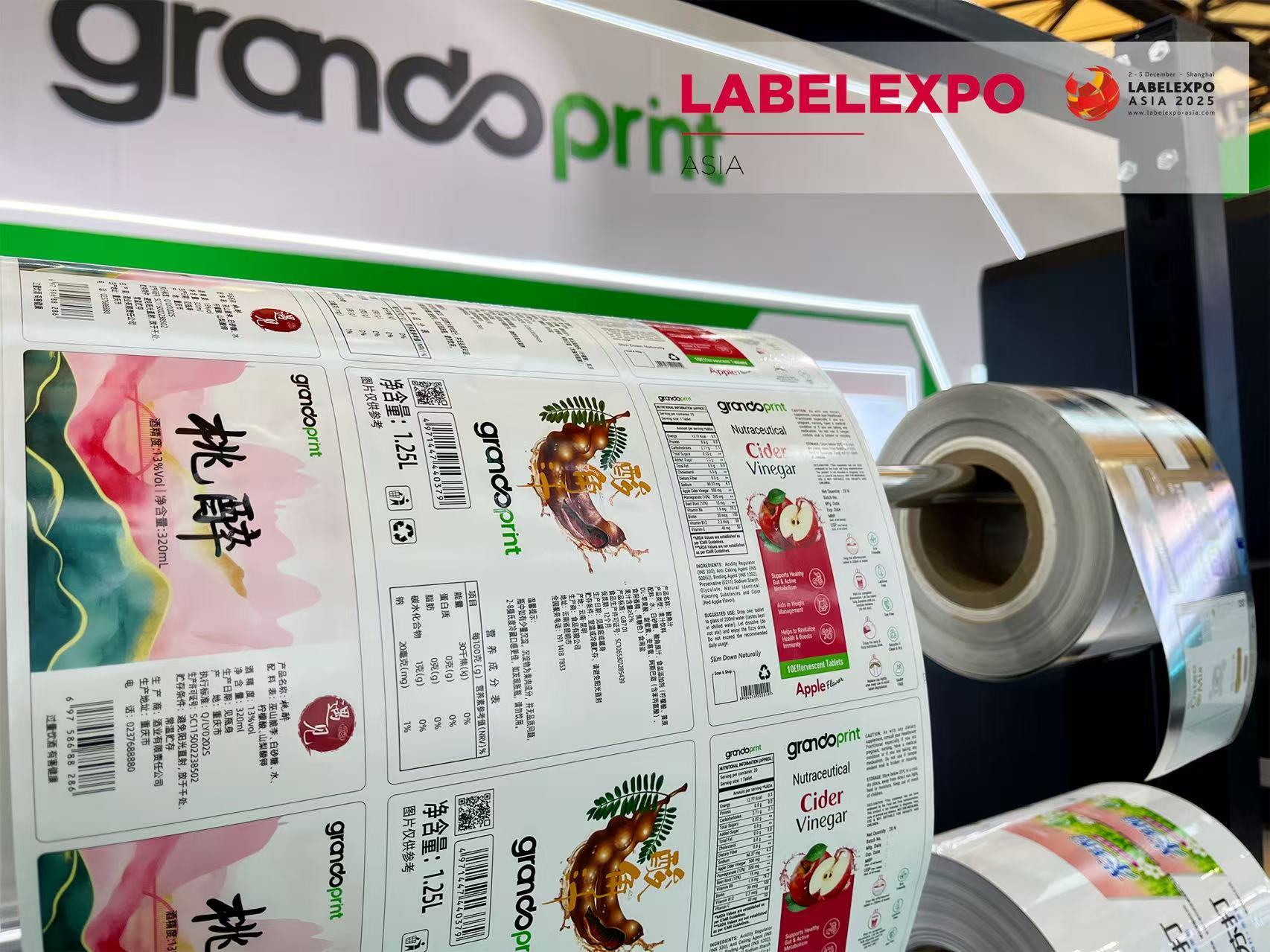
A coated-paper label sample: acceptance should be signed on the buyer's own substrates and artwork, not on a demonstration file.
4. Support, printhead care and a growth path you can schedule
Grandoprint's published service scope covers on-site installation, commissioning and trial operation after equipment delivery; operator training on equipment operation and routine maintenance; telephone, remote online and on-site technical support; remote monitoring of equipment operating status with fault warning; original spare parts supply with fast response support; localized service through technical service centres or authorized distributors in overseas markets; and upgrade services covering software version upgrades and hardware module expansion.
Printhead care is where that scope meets daily production. The GR350S uses Epson S3200-U1 / S3200-U3 printheads in a piezoelectric inkjet configuration. Three controllable conditions do most of the work: a dust-free workshop, humidity held at 40–60% so that static and droplet placement stay within range, and ink stored at 16–32°C with constant temperature control. Grandoprint's application notes add the operational rule that stable roll-to-roll printing requires proper tension control, clean workshop conditions, a stable power supply and regular printhead maintenance. None of those items is a service-level guarantee; together they are the maintenance discipline that determines whether the printheads reach their expected life.
The growth path is modular by design. Pre-coating is optional and corona treatment is supported for PE, PET, BOPP, PP and OPP films. A post-coating varnish system is optional, spot varnish enhancement is supported, and dual UV curing is part of the press configuration. Because the same platform carries these modules, a factory that starts with short-run packaging and cosmetic labels can move into premium varnished work later — provided the roadmap is visible when the order is placed, since lead time is configuration-dependent.
Step-by-step: from purchase order to steady production
- Freeze the configuration sheet. Confirm printhead configuration, ink (CMYKW with optional varnish), voltage standard for the destination market, software language, machine branding, spare parts package and any optional modules. This is the document every later conversation refers back to.
- Prepare the site against the checklist. Three-phase 380VAC 50/60 Hz power at approximately 10 kW, 0.6–0.8 MPa clean dry air, 18–32°C ambient, 40–60% humidity, dust-free workshop, and a cleared area around the 2850 × 1400 × 2040 mm footprint with roll storage for 700 mm unwind diameters.
- Submit production substrates for testing. Send the actual film and paper stocks, including PET, BOPP, PP, PE, OPP and synthetic label materials. Difficult stocks may need corona treatment or pre-coating; heat-sensitive films need curing settings reviewed before the run.
- Write the acceptance protocol. Define artwork, variable-data files, speed band, colour target, defect threshold, QR/barcode readability and sign-off authority. Agree whether acceptance happens at the factory, on site, or both.
- Witness factory testing. Review the 100% functional testing record, the inline sensor and vision monitoring results, and the CIS-based real-time defect detection output before the machine is packed.
- Commission on site. Installation, commissioning and trial operation are followed by checks on tension control, intelligent deviation correction and label sensor mark tracking across a full production roll.
- Train operators and fix the maintenance routine. Training covers equipment operation and routine maintenance; the routine should also record ink storage temperature, workshop humidity and the printhead maintenance interval so that drift is visible before it becomes a print defect.
- Plan the first three months of live work. Start with the job mix used in acceptance, then review actual order data before deciding whether pre-coating, post-coating varnish or spot varnish should be added to the platform.
Use cases: where this agreement structure pays off
Multi-SKU label factories
Where orders turn over quickly and micro-batch work is a meaningful share of volume, the GR350S reduces traditional plate-making steps and shortens job setup time. Acceptance should therefore include changeover time and variable-data throughput, not only print quality on a long run.
Packaging converters adding short-run capacity
A packaging digital label printer at 110–350 mm printing width and 20–100 m/min covers multi-SKU packaging labels, beverage and food labels, and daily chemical work alongside existing conventional lines. The site checklist matters more here, because the digital press is usually installed into a building already running other equipment.
Cosmetic and premium label producers
Cosmetic label printing typically requires varnish control. On the GR350S, CMYKW plus optional varnish, spot varnish enhancement, dual UV curing and an optional post-coating varnish system are the relevant configuration levers. A buyer planning shelf-ready skincare or fragrance labels should lock the varnish decision at order stage rather than after the first premium enquiry.
Film and synthetic-paper specialists
PE, PET, BOPP, PP and OPP film labels behave differently from paper, and adhesion is the acceptance criterion that matters. Corona treatment is supported and pre-coating is optional; testing those stocks before batch production is the difference between a signed acceptance and an open dispute.
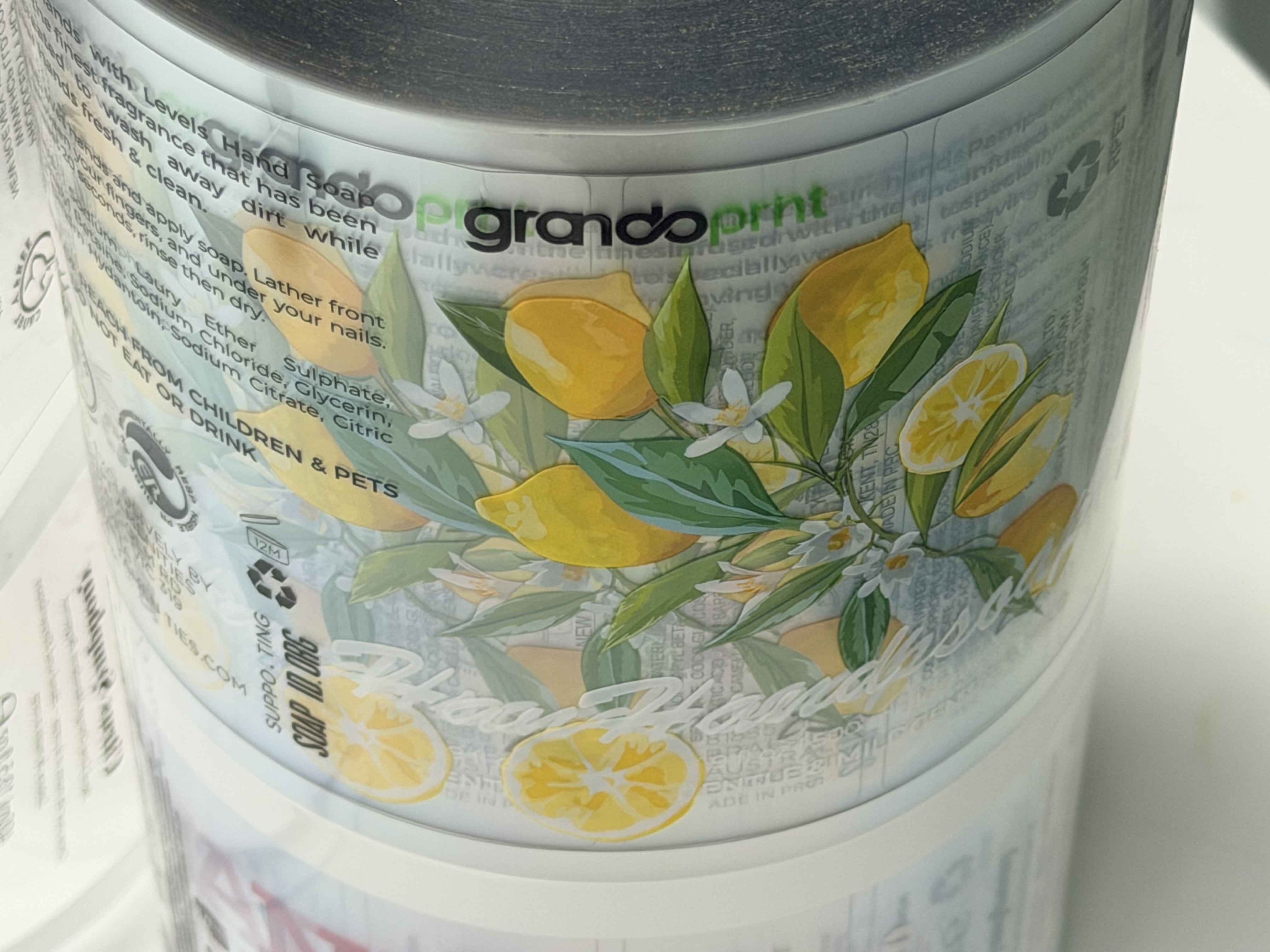
Clear PET label sample: film stocks should be part of the acceptance run, not a post-installation experiment.
Variable data and traceability work
QR code labels, barcode labels, serial numbers and anti-counterfeit labels are printed directly from a database configuration without batch PDF conversion, with label sensor mark tracking keeping registration aligned. For serialized logistics or pharmaceutical work, readability and data accuracy testing belongs in the acceptance protocol.
One OEM customer operating label printing and packaging production in Brazil and Italy took delivery of 20 units over one year. The reported result was stable operation with high printing consistency and a 30% reduction in production setup time, with variable data printing and multi-SKU adaptability highlighted as the fit. It is a supplier-reported result for a specific configuration, not a universal benchmark, but it shows what a well-documented acceptance and training schedule is meant to protect.
Comparison tables for the contract meeting
The first table summarises the configuration options that are usually still open at quotation stage. The second converts the published support and specification facts into a checklist of items to confirm in writing.
| Configuration option | Documented GR350S position | When it matters |
|---|---|---|
| Base UV inkjet configuration | Piezoelectric inkjet; Epson S3200-U1 / S3200-U3 printhead; CMYKW with optional varnish; 20–100 m/min; printing width 110–350 mm | Short-run, multi-SKU paper and film label work within the standard specification |
| Corona treatment unit | Supported; compatible film materials listed as PE, PET, BOPP, PP and OPP | Film labels where UV ink adhesion needs improvement before batch production |
| Pre-coating system | Optional | Difficult or low-surface-energy stocks being qualified for long-term production |
| Post-coating varnish system | Optional | Premium and cosmetic labels where finish and protection are part of the specification |
| Spot varnish enhancement | Supported | Brand and decorative labels requiring a selective gloss or tactile effect |
| Dual UV curing | Supported | Higher-speed curing control, including heat-sensitive film work |
| Item to confirm in writing | Documented position | What the contract should state |
|---|---|---|
| Minimum order quantity | 1 unit | Whether OEM configuration changes affect the minimum |
| Lead time | Around 60 days after order confirmation, depending on configuration, quantity, testing requirements and production schedule | Milestone dates for factory testing, packing and shipment |
| Warranty | Usually 1 year, subject to contract terms | Covered components, claim process, and how printhead wear is treated |
| Pre-delivery testing | 100% functional testing; inline sensors and vision; CIS-based real-time defect detection | Access to test records and the right to witness testing |
| Installation and commissioning | On-site installation, commissioning and trial operation after delivery | Site readiness conditions that must be met before the engineer travels |
| Operator training | Training on equipment operation and routine maintenance | Number of operators trained and language of delivery |
| Technical support | Telephone/remote online support and on-site maintenance services; remote monitoring with fault warning | Escalation path and who is the named contact |
| Spare parts | Original spare parts inventory with fast response support | Recommended spares holding for the first year of production |
| Localized service | Technical service centres or authorized distributors in overseas markets | Which location covers the buyer's region |
| Upgrades | Software version upgrades and hardware module expansion | How module additions are quoted and scheduled later |
FAQ: the questions buyers ask after the quotation
What site conditions and documentation must be settled before the machine ships?
The published site requirements are a three-phase 380VAC, 50/60 Hz supply with approximately 10 kW power consumption, clean dry compressed air at 0.6–0.8 MPa, ambient temperature of 18–32°C, humidity of 40–60%, dust-free workshop conditions, and a 2850 × 1400 × 2040 mm footprint. Ink storage should stay at 16–32°C with constant temperature control. On documentation, treat it as a request rather than an assumption: the material used for this article confirms the electrical configuration but does not publish conformity document numbers, so the applicable declarations for the destination market should be requested and verified per order. Where the finished label itself must satisfy a standard — UL 969 for marking and labeling systems is the common North American reference for label durability — that belongs in the acceptance protocol as a label test, separate from any statement about the machine.
Can one GR350S cover cosmetic, food, film and variable-data work as volume grows?
The platform is specified for printing widths of 110–350 mm, media widths of 120–360 mm and speeds of 20–100 m/min, with CMYKW plus optional varnish, optional pre-coating, supported corona treatment, optional post-coating varnish and dual UV curing. Grandoprint lists cosmetic labels, food and beverage labels, daily chemical labels, film labels on PE, PET, BOPP, PP and OPP, and variable-data work such as QR codes, barcodes, serial numbers and anti-counterfeit labels as applications. The limit is substrate qualification, not product category: difficult films may require corona treatment or pre-coating, and heat-sensitive films need curing settings and temperature control reviewed before batch production.
What drives cost over a multi-year relationship, if not the purchase price?
Grandoprint does not publish price data in the material used for this article, so the honest answer is structural rather than numeric. The cost lines that repeat every year are consumables (CMYKW ink with optional varnish), electrical consumption at approximately 10 kW, spare parts from the original inventory, and the labour and waste associated with changeovers. Two levers sit with the buyer: site quality — stable power, clean dry air, controlled humidity and a dust-free workshop — protects uptime and printhead condition, and training on operation and routine maintenance reduces avoidable waste. A third lever is timing: optional modules such as pre-coating or post-coating varnish are cheaper to plan with the original order than to retrofit later, because lead time depends on configuration.
How do we validate print quality on our own material before signing?
Test on production stock, not demonstration stock. Send the actual paper, PET, BOPP, PP, PE, OPP or synthetic label materials, and ask for samples that include the variable-data work you intend to sell. The check list is: colour and resolution on your artwork, ink adhesion after corona treatment or pre-coating where required, QR code and barcode readability, white ink and varnish behaviour if configured, and registration stability across a full roll under mark tracking and intelligent deviation correction. Grandoprint supports sample testing as part of its service scope, and its application guidance recommends testing film and synthetic materials before batch production for exactly this reason. A sample request can be raised through grando-dg.com.
How long from order to production, and how are installation and training scheduled?
Lead time is around 60 days after order confirmation, depending on machine configuration, order quantity, testing requirements and production schedule, with a minimum order quantity of 1 unit and monthly capacity of 100 units. On-site installation, commissioning and trial operation follow delivery, and operator training on equipment operation and routine maintenance is part of the service scope. The realistic total timeline is therefore the lead time plus site preparation plus the commissioning and training window — which is why the site checklist in this article should start on the day the order is placed, not on the day the machine arrives.
Conclusion: what a long-term digital label printer partnership actually contains
A multi-year supplier relationship is not a sentiment; it is a set of documents. For the GR350S, those documents can be built almost entirely from published facts: a configuration sheet covering printhead and ink configuration, voltage standard, software language, branding, spare parts and optional modules; a site checklist built around three-phase 380VAC, 10 kW, 0.6–0.8 MPa air, 18–32°C, 40–60% humidity and a 2850 × 1400 × 2040 mm footprint; an acceptance protocol that tests real substrates, real variable-data files and real adhesion behaviour after corona treatment or pre-coating; and a support schedule that names installation, commissioning, training, remote monitoring, spare parts and upgrade routes, with a warranty that is usually one year and therefore needs its scope written down.
Nanjing Grando Digital Technology Co., Ltd. was founded in 2010 and operates dual bases in Nanjing and Shanghai covering more than 20,000 m², with 500+ employees, a 30-person R&D team, and a technical service group with more than 20 years of experience and over 16 years of printing equipment manufacturing behind it. The company exports around 70% of its output to markets including the United States, Brazil, Mexico, Australia, Thailand, Germany, Italy, Kuwait, Angola and Ivory Coast. Those facts explain the service footprint; they do not replace a negotiated contract. Buyers should use them to ask better questions, and use the contract to record the answers.
Next step: sample, quote or brochure
If you are past the quotation stage and want to test the acceptance questions on your own stock, request a printed sample set on your substrate, or ask for a configuration review covering pre-coating, post-coating varnish and corona treatment before the order is finalised.
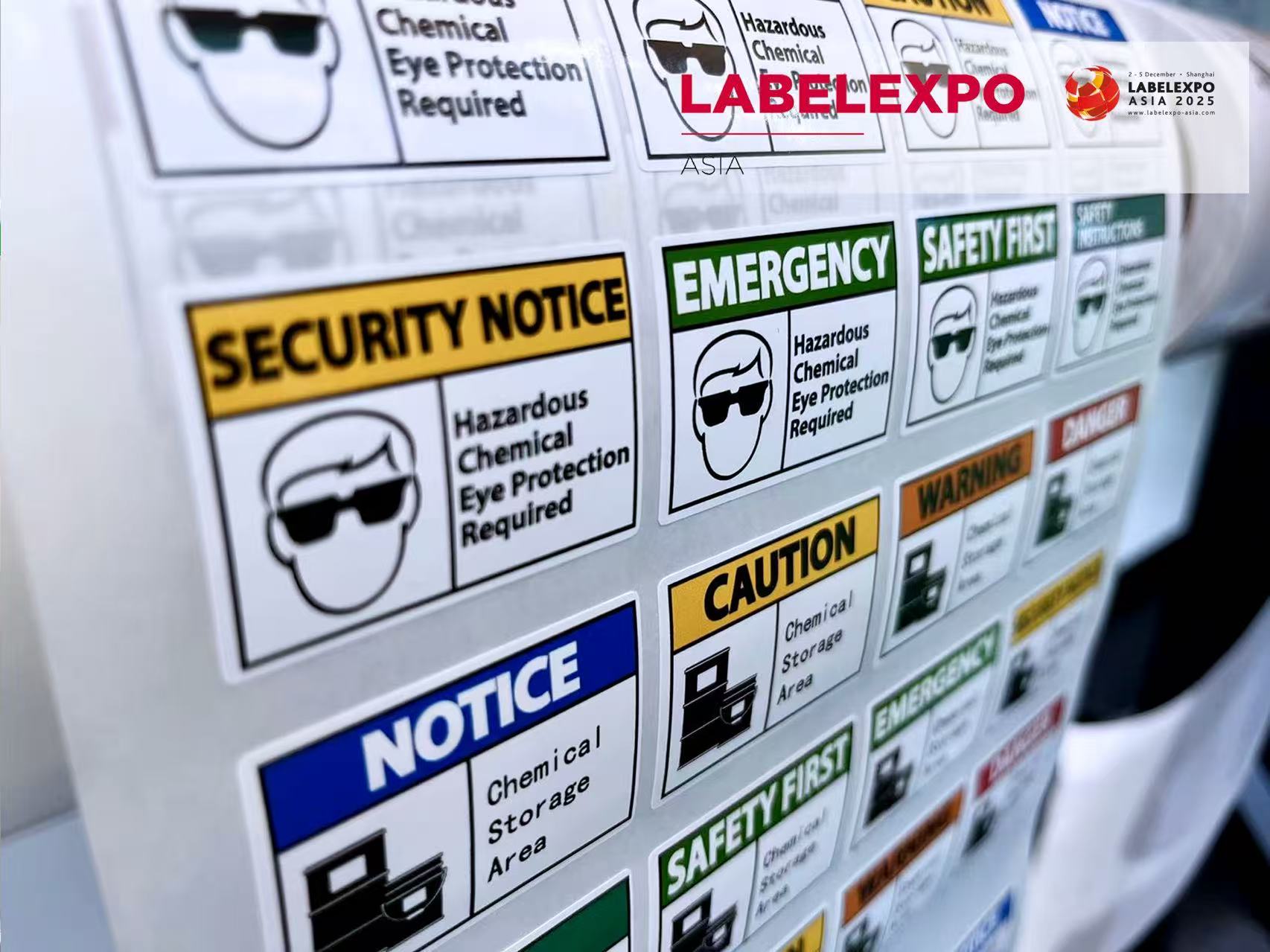
Sample label output, including variable-data and warning labels, printed on the GR350S platform.
- Download the product brochure:GR350S digital label printer brochure (PDF)
- Website:www.grando-dg.com
- Email: juliawu@grando-dg.com | Tel / WhatsApp: +8613805155194
- Address: No.9 Shengshui Road, Lishui Development Dist, Nanjing City, China
Nanjing Grando Digital Technology Co., Ltd. (Grandoprint) — digital inkjet equipment manufacturer, founded 2010.
Have Questions or Need More Details?
Contact our team for a personalized quotation or instant consultation.
Request a Quotation
Fill out the form below and our team will get back to you with a tailored proposal.
WhatsApp Direct Chat
Prefer to chat in real-time? Message us on WhatsApp for instant assistance & quick answers.
- Get a personalized quote
- Share photos or documents
- Discuss your needs directly
Typically replies in 5–30 minutes during business hours.