
Film Label Ink Peeling? Solving UV Adhesion Problems on PE, PET, BOPP and PP
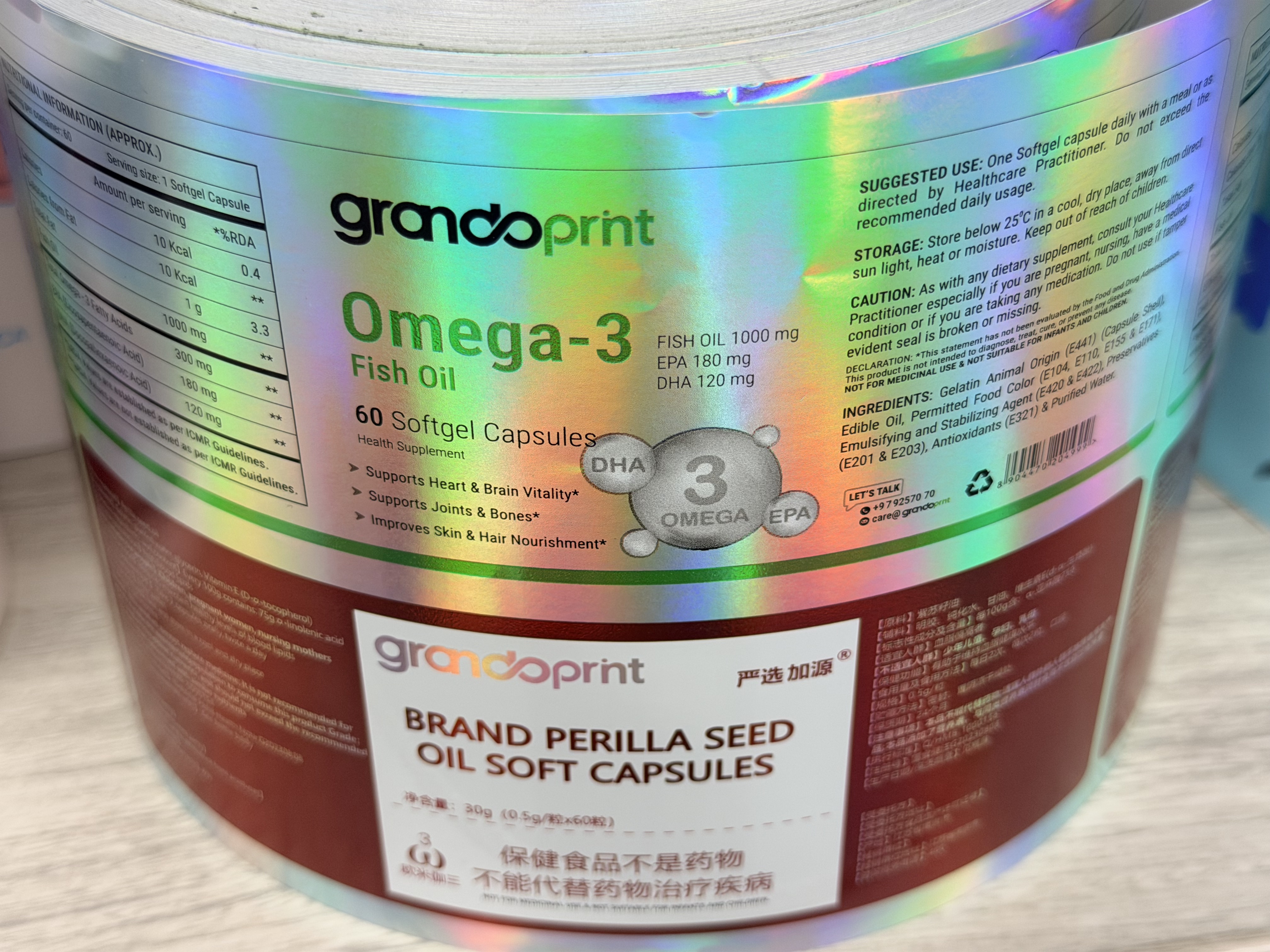
Bright silver BOPP film label sample. On metallized, clear and white films the ink layer sits on the surface, so an adhesion problem has nowhere to hide.
A converter runs a cosmetic label on clear BOPP. The first-off looks sharp, the colour matches, the varnish is glassy. Three days later the brand owner runs a rub test with a solvent-dampened cloth and the ink moves. Or the labels reach the filling line and the print flakes along the die-cut edge as the liner is stripped. The press did not change overnight. The film did not change. What changed is that nobody had verified adhesion on that specific film with that specific ink and varnish combination.
Ink peeling on film labels is a surface-engineering problem before it is a print-quality problem. On PE, PET, BOPP, PP and OPP, UV ink does not soak into the substrate - it has to bond to it. Four variables decide whether that bond survives a rub test, a labelling line and a chilled retail environment: the film surface energy and how it is pre-treated, the ink laydown and ink chemistry, the UV cure energy applied, and the coating or varnish route laid over the print.
This article breaks down what actually fails on film labels, and how a roll-to-roll UV digital label printer configured with a corona treatment module, dual UV curing and a post-coating varnish system - using the Grandoprint GR350S specification set as the reference configuration - lets a converter control all four variables in a single pass. It closes with a practical troubleshooting checklist covering substrate selection, adhesion testing and varnish choices for PE, PET, BOPP, PP and OPP.
What "Ink Peeling" Actually Looks Like on a Film Label
"Ink peeling" is an umbrella term. In production it appears as one of five distinct failures, and each one points at a different part of the process:
- Rub-off or smudging. Ink transfers to a cloth, a thumb or a packaging-line contact point under light pressure. This is the classic untreated-surface or under-cure signature.
- Flaking at the die-cut edge. The print lifts in small shards along the cut line or where the matrix is stripped - often linked to a brittle, over-cured ink film or to mechanical stress at the edge.
- Cracking in heavy coverage. White ink and dense solids crack or craze when the label is applied around a curved bottle or a squeezable container.
- Loss of gloss or hazing. The varnish dulls, or reacts with the film or the ink beneath it.
- Scan and readability failures. QR codes and barcodes drift out of tolerance after curing or handling because print quality or contrast changes.
Each of these can pass a visual check at the rewind station and still fail at the customer. That is why film label adhesion is verified with tests - rub testing, tape or cross-hatch testing, and application simulation - rather than with a visual inspection alone.
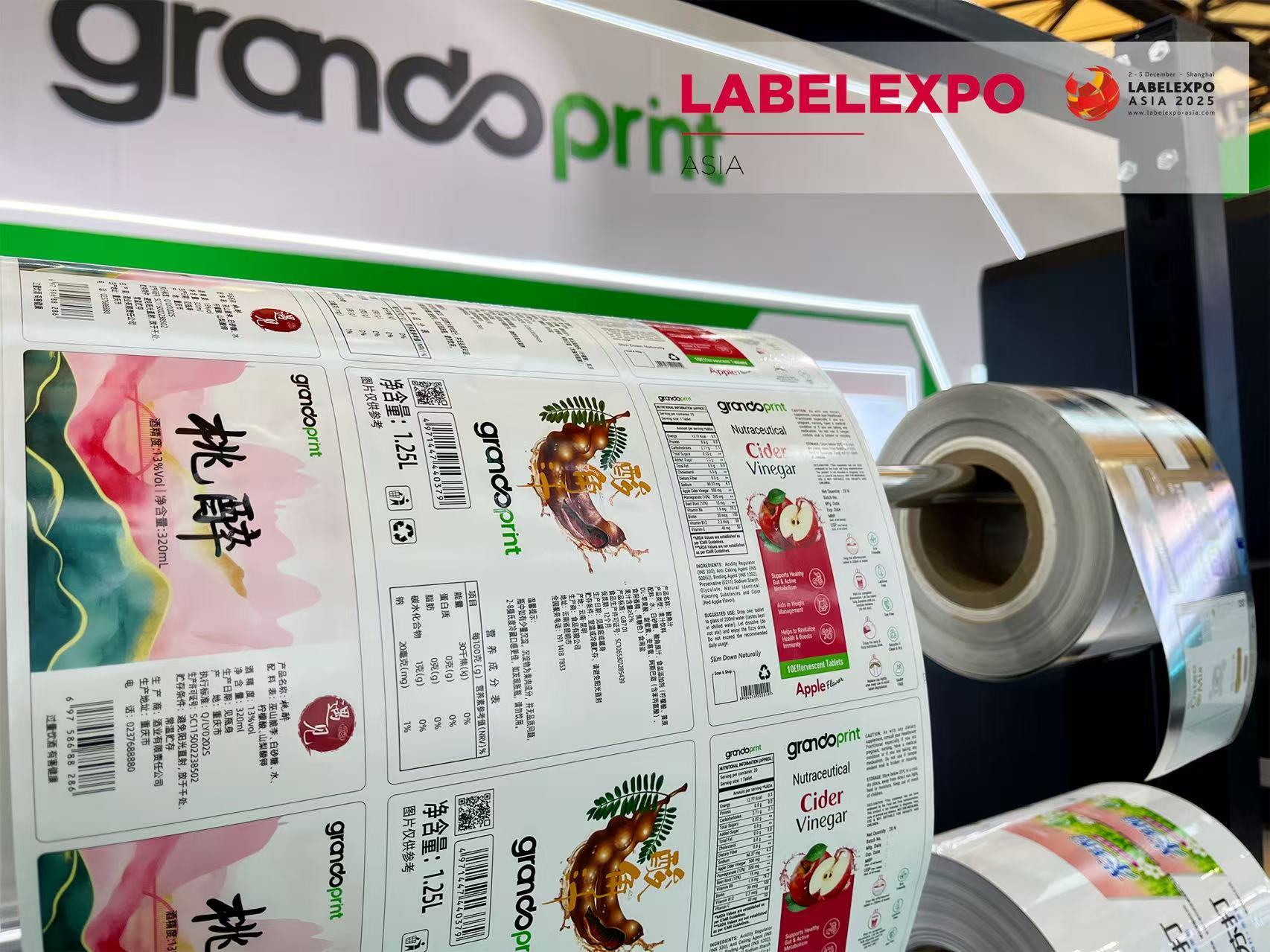
Coated paper labels absorb part of the ink vehicle and key mechanically. Film labels do neither, which is why the same print file can behave completely differently across substrates.
Why Film Substrates Behave Differently From Paper
Paper and coated paper labels absorb part of the ink vehicle and mechanically key the dried film. Film does not. PE, PET, BOPP, PP and OPP are non-porous, and several of them present low surface energy, which means a UV ink droplet landing on an untreated surface has very little to hold onto. The printed layer is, in effect, a thin plastic film resting on another plastic film.
The commercial stakes rise with the volume. Market Research Future values the global digital label printer market at USD 3.097 billion in 2024 and projects it to reach USD 8.654 billion by 2035, a 9.79% CAGR over 2025-2035. Inkjet systems are estimated to hold a 46% share of the digital label printing market by system type in 2025 (Future Market Insights), and industrial label printers account for approximately 42.5% of the total label printer market (Dataintelo). As more everyday label work - cosmetics, beverage, daily chemical and flexible packaging labels - moves onto digital inkjet, adhesion control stops being a troubleshooting topic and becomes a production discipline.
There is a compliance dimension as well. In the European Union, digital label printers must comply with the RoHS Directive (2011/65/EU) and the EMC Directive (2014/30/EU) to carry CE marking. Buyers running film label work into the EU should collect the equipment documentation alongside the adhesion test results, because both determine whether a job can ship.
The Root Causes of UV Ink Adhesion Failure on PE, PET, BOPP, PP and OPP
1. Low surface energy and insufficient pre-treatment
Adhesion starts with the film surface, not the printhead. Untreated polyolefin films such as PE and PP typically present low surface energy, and UV ink has difficulty anchoring to them. Corona treatment raises surface energy and creates polar groups on the film surface so the ink can bond. The critical detail is that corona treatment is a process variable, not a one-time setting: treat level drifts with electrode condition, with the type and amount of slip agent and additive in the film, and with line speed.
This is the constraint that film-capable press configurations are built around. Some difficult-to-print materials require corona treatment or another surface treatment to improve UV ink adhesion, and those materials - PET, BOPP, PVC, PP, PE, OPP films and synthetic label materials - should be tested before batch production rather than assumed to behave like paper.
2. Cure energy that is either too low or too high
Under-cured UV ink stays soft. It smudges under a rub test, transfers onto rollers and applicator parts, and can migrate in storage. Over-cured ink becomes brittle: it survives the press and then cracks or flakes when the label is die-cut, stripped from the liner or applied to a curved surface. Heat-sensitive films add a second constraint, because excessive UV energy and temperature can deform or discolour the film itself. The usable cure window is therefore a narrow, material-specific band that has to be set per job - not copied from the last run.
3. Ink laydown, white ink and ink chemistry
White ink is where a large share of film label failures begin. White is an opaque, high-laydown colour, and on film it is usually printed as a base or as a heavy highlight. The thicker the ink film, the higher the internal stress at the ink-to-film interface - and the more visible any cracking becomes. Ink chemistry matters as well: UV ink sets are not interchangeable across PE, PET and BOPP, and jetting stability depends on printhead condition and routine maintenance.
4. Varnish and coating choices
What the customer touches is often the varnish, not the ink. If the varnish is incompatible with the film or with the ink underneath it, the label can look perfect at the rewind and still haze, dull or scuff in transit. Varnish and coating selection is a material decision rather than a cosmetic one - and it is one of the few variables a converter can change without rebuilding the entire ink set.
5. Tension, dust, static and the production environment
Stable roll-to-roll film printing depends on proper tension control, a clean workshop and a stable power supply, supported by regular printhead maintenance. Static is a specific risk on film: low humidity increases static build-up, which attracts dust to the web and creates weak points in the print. The GR350S application profile specifies a production environment of 18-32 C, 40-60% relative humidity and a dust-free workshop, with three-phase 380VAC power and clean, dry compressed air at 0.6-0.8 MPa.
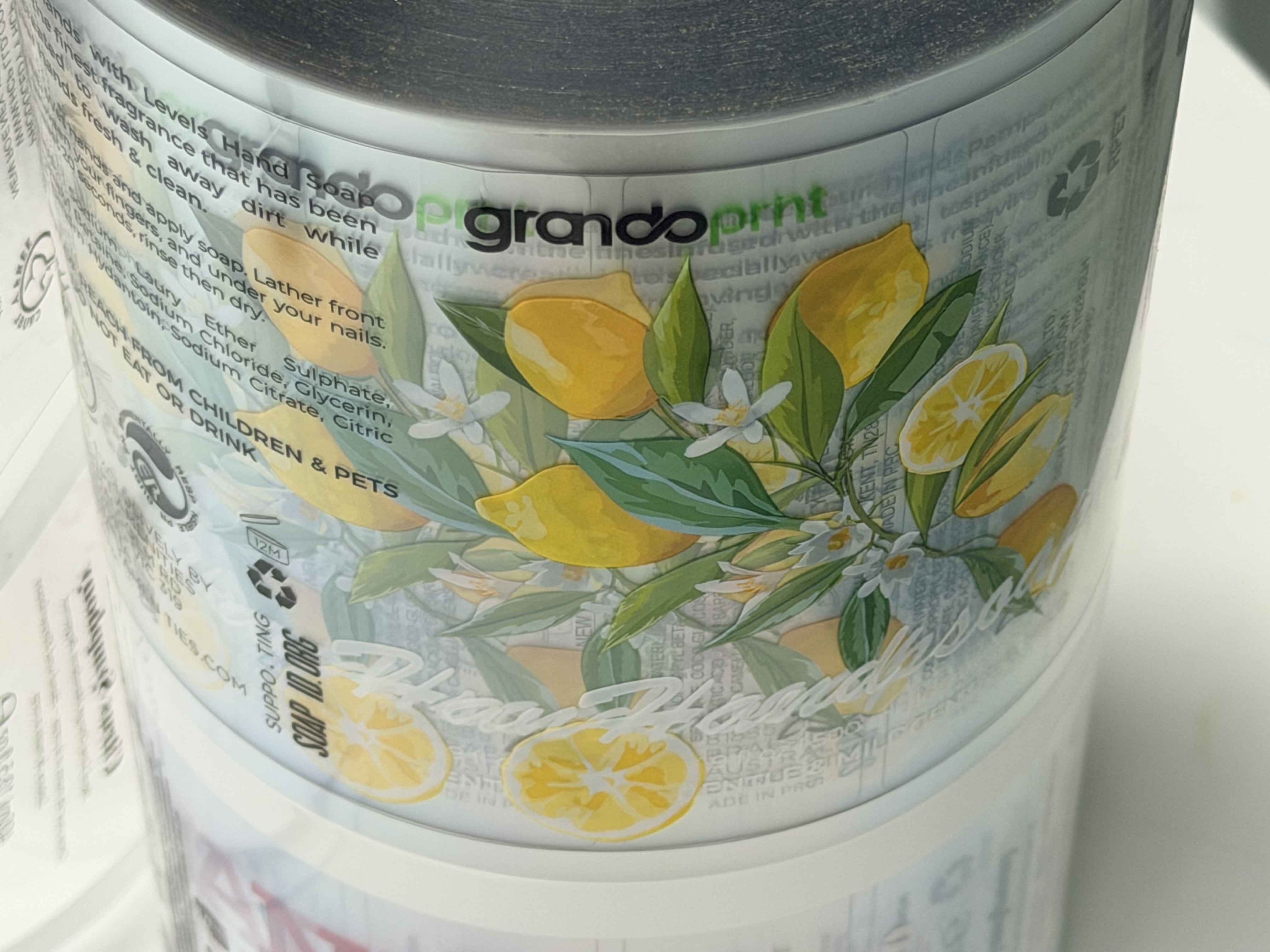
Clear PET label sample. Transparent film gives no hiding place for weak adhesion - rub-off and hazing are immediately visible to the brand owner.
How a Roll-to-Roll UV Digital Label Printer Solves Adhesion Problems in One Pass
The Grandoprint GR350S is a roll-to-roll UV label printer, classified as a variable data digital label printer and also as a QR code and barcode label printer, built for label production and packaging label work. What makes it relevant to adhesion problems is that it carries the three corrective stages - surface treatment, curing and coating - inline, so a converter can control them per job instead of depending on whatever the film supplier happened to ship.
Corona treatment module: controlling the surface before the ink lands
In its film configuration the machine is a film label UV inkjet printer for PE, PET, BOPP, PP and OPP, and it includes a corona treatment module to improve ink adhesion on difficult substrates. Treating the web in line means the treated surface is fresh when the ink arrives - one of the reasons inline pre-treatment behaves more consistently than pre-treated stock that has been sitting in storage.
Dual UV curing: curing the ink without cooking the film
The GR350S supports dual UV curing with UV digital piezoelectric inkjet printing and an Epson S3200-U1 or S3200-U3 printhead. Dual curing gives the operator a wider, more controllable cure window than a single lamp stage, which matters most on heat-sensitive films where the objective is a fully cross-linked ink film without over-exposing the substrate.
Varnish and post-coating: protecting the print and the bond
The ink configuration is CMYKW plus optional varnish, with spot varnish enhancement supported and an optional post-coating varnish system. An optional pre-coating system is also available. In practice this keeps the finish decision - plain CMYKW, an overprint varnish, a spot varnish effect, or a full post-coating pass - inside the same production run, and it can be set per job rather than negotiated per supplier. Because material compatibility varies, the correct coating route for a given film should be confirmed by testing.
Roll-to-roll control: keeping the web stable under the ink
Adhesion testing is meaningless if registration and tension drift. The GR350S uses an industrial metal frame and sheet-metal enclosure with precision metal rollers, a roll-to-roll feeding and rewinding system and an electrical control cabinet. A label sensor for mark tracking and intelligent deviation correction support consistent registration, with an unwinding diameter of up to 700 mm and a printing speed of 20-100 m/min.
GR350S reference configuration for film label production
| Parameter | Specification |
|---|---|
| Model | GR350S |
| Machine type | Roll-to-Roll UV Label Printer; Variable Data Digital Label Printer; QR Code and Barcode Label Printer |
| Printing technology | UV digital piezoelectric inkjet printing |
| Printhead | Epson S3200-U1 / S3200-U3 |
| Ink configuration | CMYKW + optional varnish |
| Compatible film materials | PE, PET, BOPP, PP, OPP |
| Surface treatment | Corona treatment module supported |
| Coating and finishing | Pre-coating system optional; post-coating varnish system optional; spot varnish enhancement supported; dual UV curing supported |
| Printing width | 110-350 mm |
| Acceptable media width | 120-360 mm |
| Printing speed | 20-100 m/min |
| Unwinding diameter | Max. 700 mm |
| Register control | Label sensor for mark tracking; intelligent deviation correction |
| Power supply | 380V; power consumption approx. 10 kW |
| Dimensions | 2850(W) x 1400(D) x 2040(H) mm |
| Typical applications | Film labels, cosmetic labels, beverage labels, flexible packaging labels, QR code labels, barcode labels, anti-counterfeit labels, serialized labels, product traceability labels |
Step-by-Step: Setting Up a Film Label Job for Reliable Adhesion
The following sequence is a practical order of operations for a film label job on equipment such as the GR350S. It is written for converters moving a job from paper to film for the first time, or troubleshooting a film job that has started failing.
- Qualify the substrate before you quote the job. Record the face stock, the topcoat (if any), the liner and the supplier batch. PET, BOPP, PVC, PP, PE, OPP films and synthetic label materials should be tested before batch production, and the surface energy of the delivered roll should be confirmed rather than assumed from the technical data sheet.
- Verify pre-treatment. Confirm the corona treatment module is active and that treat level matches the film. On a new material, treat level is the first variable to check and the first to re-check when a previously stable job starts peeling.
- Set ink laydown and the white ink strategy. Reduce total ink film thickness where the design allows it, and treat white as the critical layer rather than as background. Confirm that the ink set is compatible with the specific film and with the coating route you intend to run.
- Balance dual UV curing against the film's heat tolerance. Set cure energy for full cross-linking, then watch for the opposite failure: deformation or discolouration of heat-sensitive film. The correct cure setting is the one that passes both the rub test and the film appearance check.
- Decide the coating and varnish route. Choose between plain CMYKW, CMYKW plus varnish, spot varnish enhancement, or an optional post-coating varnish pass - based on the application, not on the visual effect alone.
- Lock tension, registration and web cleanliness. Use mark tracking and deviation correction, maintain proper tension control, and keep the workshop dust-free. Regular printhead maintenance belongs in the job schedule, not in a repair visit.
- Test adhesion, do not eyeball it. Run a rub test, a tape or cross-hatch test, and an application simulation on the finished roll. For QR code, barcode, serial number and anti-counterfeit labels, test readability and data accuracy as part of the same sign-off.
- Document and lock the recipe per SKU. Record film supplier and batch, corona setting, ink laydown, cure settings, varnish route and test results. That record is what makes the next reprint repeatable.
Troubleshooting Checklist for Film Label Adhesion
Use this table when a film label job shows a specific failure. Each row links the visible symptom to the most likely cause and to a first corrective action that stays inside the material and process facts above.
| Symptom | Likely cause | First action |
|---|---|---|
| Ink smudges on rub test, film only (paper jobs are fine) | Low surface energy or insufficient corona treatment | Verify the corona treatment module is active and correctly set; confirm surface energy with the film supplier; re-test before running the batch |
| Ink flakes along die-cut edges after stripping | Over-cured, brittle ink film combined with mechanical stress | Re-check UV curing settings, then review tension control and web handling at the die station |
| White ink cracks on flexible or curved applications | Heavy ink laydown and high internal stress at the interface | Reduce white laydown where the design allows; confirm material compatibility and re-run adhesion testing |
| Ink transfers to rollers or applicator parts after storage | Incomplete cure | Verify UV curing output and speed; check printhead maintenance status and ink/material compatibility |
| Varnish dulls or hazes after printing | Varnish or coating incompatibility with the film or the ink | Compare the available varnish routes - overprint varnish, spot varnish enhancement, optional post-coating - on the actual material |
| Film deforms or discolours after curing | Excessive UV energy or temperature on heat-sensitive film | Adjust UV curing settings and temperature control; treat the film as heat-sensitive from the start of the setup |
| QR or barcode readability drops | Print quality or contrast drift | Test readability and data accuracy on the finished roll as part of sign-off, not at the rewind station |
| Registration drifts across the roll | Web tension or lateral deviation | Confirm mark tracking and deviation correction are working; review tension control and workshop conditions |
Substrate Selection Guide: PE, PET, BOPP, PP and OPP
The GR350S film configuration lists PE, PET, BOPP, PP and OPP as compatible film materials, and supports a corona treatment module for improved ink adhesion on difficult substrates. The table below summarises what that means per substrate type, and where each material is typically used.
| Substrate | Status in the GR350S film configuration | Adhesion consideration | Typical label applications |
|---|---|---|---|
| PE | Listed compatible film material; corona treatment module supported | Polyolefin film that typically requires pre-treatment and pre-batch testing before production | Film labels and flexible packaging labels |
| PET | Listed compatible film material; corona treatment module supported | Non-porous and dimensionally stable; treat level should be confirmed on the delivered batch | Cosmetic labels, beverage labels, clear film labels |
| BOPP | Listed compatible film material; corona treatment module supported | Widely used metallized and white film; adhesion should be verified after any supplier change | Beverage labels, product labels, premium labels |
| PP | Listed compatible film material; corona treatment module supported | Polyolefin film requiring pre-treatment and pre-batch testing | Daily chemical labels, industrial product labels |
| OPP | Listed compatible film material; corona treatment module supported | Flexible film where tension control and cure balance affect the finished result | Flexible packaging labels, film labels |
One rule applies to all five: PET, BOPP, PVC, PP, PE, OPP films and synthetic label materials should be tested before batch production. Compatibility is a per-material finding, and it can change between supplier batches.
Varnish and Coating Choices on Film Labels
Varnish is the variable most converters can change fastest, because it does not require a new ink set. The GR350S supports CMYKW plus optional varnish, spot varnish enhancement, an optional pre-coating system and an optional post-coating varnish system.
| Finish route | What it is | When to consider it |
|---|---|---|
| CMYKW, no varnish | Standard UV inkjet printing without an added varnish layer | When the application does not require a gloss or tactile effect and the material is confirmed compatible |
| CMYKW + optional varnish | Varnish included in the ink configuration | General print protection or a gloss finish on cosmetic, beverage and premium labels |
| Spot varnish enhancement | Varnish applied to selected areas to create a defined gloss or tactile effect | Logo or product-name emphasis on premium labels, decorative labels and packaging labels |
| Post-coating varnish system (optional) | A post-coating varnish stage applied after printing | Jobs where the printed surface is exposed to repeated handling or where a consistent full-surface finish is required |
| Pre-coating system (optional) | A coating stage applied before printing, available as an option on the configuration | Difficult substrates where the converter and material supplier agree that additional preparation beyond corona treatment is needed |
Because white ink and varnish are optional and depend on material compatibility and machine configuration, the correct combination for a given film should be settled by testing the actual material rather than by applying a rule from a different substrate.
Use Cases: Where Film Label Adhesion Is Tested Every Day
Adhesion failures rarely appear on the same job that caused them. They surface in the applications where film labels are worked hardest:
- Cosmetic and skincare labels on clear film. Transparent PET and similar films make haze, rub-off and cracking immediately visible. Cosmetic label work is a natural fit for dual UV curing, spot varnish enhancement and an optional post-coating varnish system, with an ink configuration of CMYKW plus optional varnish.
- Beverage and product labels on metallized or white BOPP. Bright silver and white films are common in this segment, and both depend on consistent pre-treatment to hold the ink.
- Daily chemical and industrial labels on PP. These labels face repeated handling, storage and, in some cases, chemical contact - conditions where an under-cured print fails quietly.
- Flexible packaging labels on OPP and PE. Flexible films combine low surface energy with movement during application, so tension control and cure balance matter as much as the ink itself.
- Serialized, QR code, barcode and anti-counterfeit film labels. Variable data work adds a readability requirement on top of adhesion. Variable data processing is supported on the GR350S, and readability and data accuracy should be tested as part of the adhesion sign-off.
- Short-run and multi-SKU film label work. Frequent job changes on film multiply the number of material combinations that have to be qualified, which is why a documented per-SKU recipe matters as much as the machine itself.
Environmental consistency is part of the case. In a label printing factory running continuous roll-to-roll film work - the scenario the GR350S application profile is written around - stable output depends on proper tension control and clean workshop conditions, with the production area held at 18-32 C and 40-60% relative humidity, three-phase 380VAC power and clean, dry compressed air at 0.6-0.8 MPa.
FAQ: Film Label Adhesion, Configuration and Testing
Do film label printers need CE, RoHS or other compliance documentation for the EU market?
Yes. Digital label printers must comply with the RoHS Directive (2011/65/EU) and the EMC Directive (2014/30/EU) for CE marking in the European Union. Compliance documentation sits alongside adhesion test results as a shipment prerequisite for EU-bound label work. On the manufacturing side, Grandoprint (Nanjing Grando Digital Technology Co., Ltd.) is ISO 9001:2015 certified (Cert No. 19926Q00205R001) for the R&D and production of digital inkjet equipment. Buyers should request the relevant declarations together with the quotation so that material and compliance questions are resolved before a batch is committed.
Can a UV digital label printer print on PE, PET, BOPP, PP and OPP without ink peeling?
It can, when the surface, the cure and the coating route are all matched to the specific film. The GR350S film configuration lists PE, PET, BOPP, PP and OPP as compatible film materials and includes a corona treatment module for improved ink adhesion on difficult substrates. Dual UV curing is supported, and the machine can be configured with an optional pre-coating system and an optional post-coating varnish system alongside a CMYKW plus optional varnish ink set. The remaining condition is procedural: difficult materials should be tested before batch production, because compatibility is a per-material result rather than a general property of the machine.
What determines the cost of a film-capable UV digital label printer?
Cost is driven by configuration rather than by a single headline figure. The variables that matter for film label work are whether the machine includes the corona treatment module and dual UV curing, whether the optional pre-coating and post-coating varnish systems are specified, and which ink configuration - CMYKW with or without varnish - is selected. Site requirements also affect the installation scope: the GR350S operates at 380V with power consumption of approximately 10 kW, needs clean, dry compressed air at 0.6-0.8 MPa, and is specified for a dust-free workshop at 18-32 C and 40-60% relative humidity. Because the right combination depends on your films and label applications, the configuration should be confirmed against tested samples before a quotation is fixed.
Can we test our own film and label stock before buying?
Yes - and on film work it is the step that removes most of the risk. Grandoprint provides global services including equipment selection, sample testing, installation, training and long-term technical support. Send the actual PE, PET, BOPP, PP or OPP stock you run, together with the label design and the finish you need, and the material can be put through printing, curing, coating and adhesion testing before a configuration is locked. Testing your own batch also catches the two things a specification sheet will not tell you: how much slip agent your film carries, and how the surface behaves after storage.
What support is available if a new film material fails adhesion after installation?
Start with the documented recipe for that SKU, then work through the troubleshooting order above - surface treatment, cure balance, ink laydown, varnish route, then tension and environment. If a new film supplier or batch is the variable, treat it as a new material and re-qualify it rather than adjusting the machine blindly. Grandoprint supports installed equipment with long-term technical support, and the company exports 70% of its output to markets including the United States, Brazil, Mexico, Australia, Thailand, Germany, Italy, Kuwait, Angola and Ivory Coast, with an annual production capacity of 15,000 units. To arrange a sample test, request a quotation, or discuss a film label application in detail, contact juliawu@grando-dg.com or WhatsApp +8613805155194. The full equipment catalogue and specifications are available in the Grandoprint digital label printer brochure (PDF).
Conclusion: Adhesion Is a Process Decision, Not a Press Setting
Film label ink peeling follows a predictable logic. PE, PET, BOPP, PP and OPP do not absorb UV ink, so the printed layer survives only if the surface energy is right, the cure is balanced, the ink laydown is controlled and the varnish route is compatible with the film underneath. When a film job fails a rub test, the fix is rarely a single button - it is a sequence of qualified decisions made per material, per SKU and per batch.
A roll-to-roll UV digital label printer that carries a corona treatment module, dual UV curing and an optional post-coating varnish system inline gives a converter the ability to control that sequence in production instead of hoping the incoming film behaves. The GR350S reference configuration - PE, PET, BOPP, PP and OPP film capability, CMYKW plus optional varnish, 110-350 mm printing width, 120-360 mm media width and 20-100 m/min - is built around that requirement, and is supported by a manufacturing operation with over 20,000 square meters of production space, a 30-engineer R&D team, and an annual capacity of 15,000 units.
The practical next step is not a purchase order - it is a test. Send your film, your label design and your finish requirement, and confirm adhesion on the material you actually run. That single test answers more about a film label project than any specification table can.

Grandoprint (Nanjing Grando Digital Technology Co., Ltd.) - digital inkjet printing equipment for label printing, packaging and industrial marking. Founded in 2010, with dual bases in Nanjing and Shanghai, over 20,000 square meters of factory area, approximately 500 employees and a 30-engineer R&D team.
Request a film label sample test or a GR350S quotation:
Email: juliawu@grando-dg.com
WhatsApp / Tel: +8613805155194
Website: www.grando-dg.com
Catalogue: Download the digital label printer brochure (PDF)
Send your PE, PET, BOPP, PP or OPP label stock, your design file and your finish requirement - we will run the print, cure, varnish and adhesion test so you can evaluate the result on your own material before you commit to a configuration.
Have Questions or Need More Details?
Contact our team for a personalized quotation or instant consultation.
Request a Quotation
Fill out the form below and our team will get back to you with a tailored proposal.
WhatsApp Direct Chat
Prefer to chat in real-time? Message us on WhatsApp for instant assistance & quick answers.
- Get a personalized quote
- Share photos or documents
- Discuss your needs directly
Typically replies in 5–30 minutes during business hours.