
GR350S vs. Modular Press: Choosing the Right Digital Label Printer
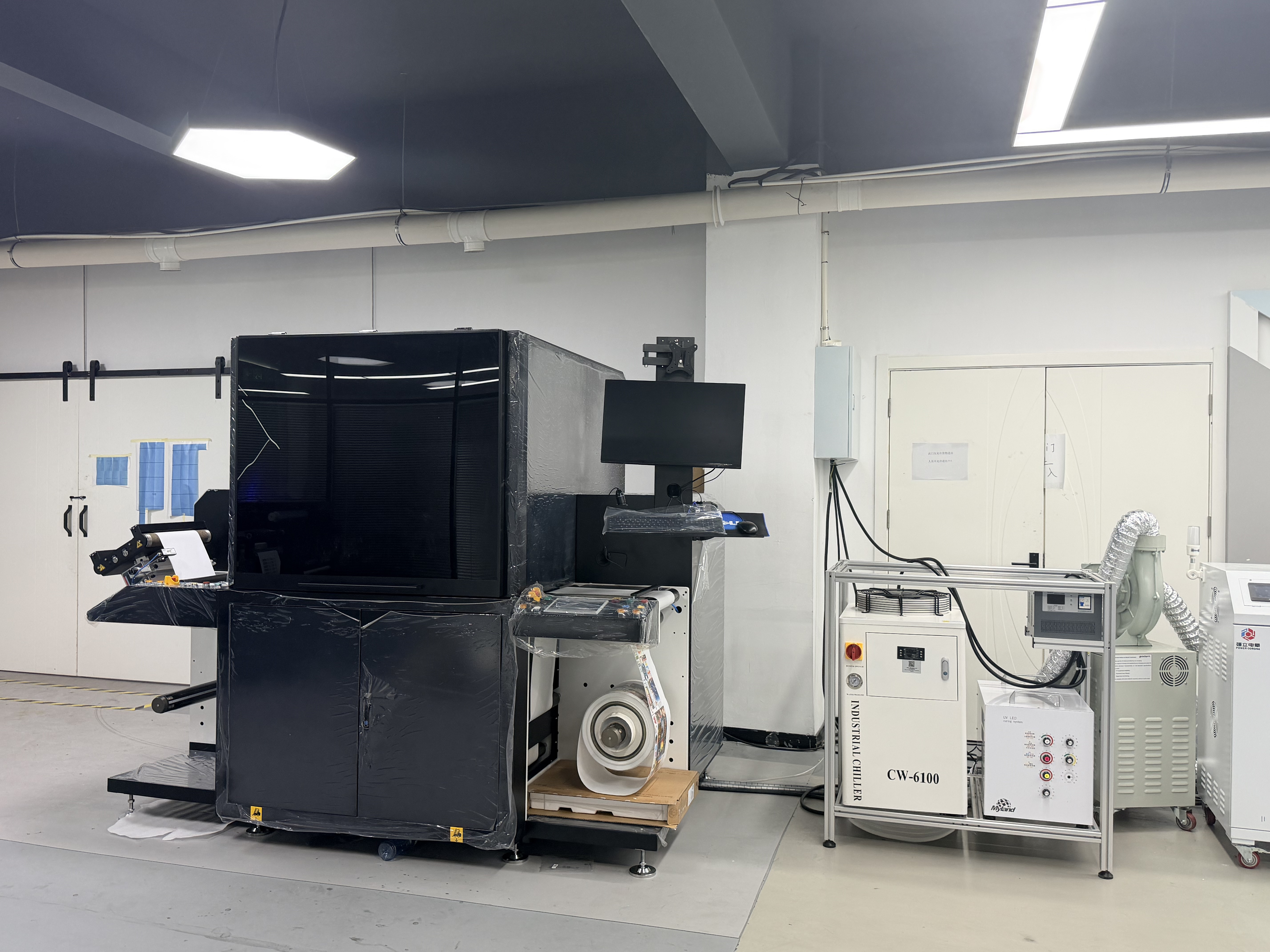
GR350S integrated roll-to-roll digital label printer in Grandoprint showroom.
When a label converter begins to evaluate production equipment, the practical choice is often between an integrated high-speed digital label press and a modular press configuration assembled from separate unwind, printing, curing, and rewinding elements. The GR350S, a roll-to-roll digital label printer manufactured by Nanjing Grando Digital Technology Co., Ltd. under the Grandoprint brand, is a useful reference point because it combines continuous roll-to-roll production, UV inkjet technology, a 380V electrical specification, and a factory-defined physical footprint in one machine. This guide compares the GR350S with a modular press path and focuses on the constraints that matter during research and evaluation: continuous output, rated voltage, floor space, printing speed, media width, and compliance evidence.
The problem: integrated press versus modular line is a constraint decision
Selection discussions often begin with print speed and maximum width, but procurement failures more frequently come from mismatches between published capability and site reality. For example, a machine rated for high speed can still produce unstable results if the unwind, tension control, curing, and rewind sections are not engineered as one system. Likewise, an impressive print engine can become difficult to operate if the facility does not have the required electrical supply or if the equipment footprint blocks planned workflow.
An integrated digital label press is usually delivered as one machine structure in which media feeding, inkjet printing, UV curing, drying, and rewinding are mounted and tested together. A modular press path, in contrast, lets a buyer combine an unwind station, a print engine, a curing unit, and a rewind station from one or several suppliers. Modularity can create flexibility, but it transfers more system-integration risk to the buyer. The line’s print quality and stability depend on how well independent modules communicate, how accurately web tension is controlled, and whether all modules share the same production philosophy.
For buyers who need continuous roll-to-roll label output, the GR350S is documented as an integrated roll-to-roll system with an acceptable media width of 120–360 mm, maximum unwinding diameter of 700 mm, intelligent deviation correction, and label sensor support for mark tracking. These are not optional claims; they are the specification boundaries that should be compared with the proposed modular line.
Industry context: digital label printing is moving into mainstream production
Market data explains why this comparison has become common. The global digital label printer market was valued at USD 3.097 billion in 2024 and is projected to reach USD 8.654 billion by 2035, according to Market Research Future. Inkjet systems were estimated to hold a 46% share of the digital label printing market by system type in 2025, according to Future Market Insights. Industrial label printers also hold the largest product segment share in the wider label printer market, accounting for roughly 42.5% of the total, according to Dataintelo.
These figures show a wider shift toward inkjet and industrial digital workflows. However, market growth does not remove the need for site-specific checks. The correct machine for one label converter may be wrong for another because of substrate mix, order length distribution, existing finishing equipment, available electrical power, or floor layout. For this reason, the following sections use the verified GR350S specification as a benchmark for evaluating both integrated and modular options.
GR350S as an integrated digital label press: a verified specification baseline
The GR350S belongs to the Grandoprint family of high-speed digital label printers. The company behind it, Nanjing Grando Digital Technology Co., Ltd., is a source factory and R&D-driven manufacturer that designs, assembles, commissions, tests, and delivers digital inkjet printing equipment. Until a buyer reaches final negotiation, however, the machine specification is more useful than the company profile.
For production planning, the GR350S provides the following published parameters from the Grandoprint product documentation:
- Model: GR350S
- Printing technology: piezoelectric inkjet printing
- Printhead options: Epson S3200-U1 / S3200-U3
- Acceptable media width: 120–360 mm
- Printing width: 110–350 mm
- Printing speed: 20–100 m/min
- Ink configuration: CMYKW plus optional varnish
- Unwinding diameter: max 700 mm
- Power supply: 380V
- Power consumption: approximately 10 kW
- Machine dimensions: 2850 (W) × 1400 (D) × 2040 (H) mm
Three constraints deserve special attention in a GR350S versus modular press comparison.
1. Continuous roll-to-roll output
Continuous production is not simply a toggled software option. It depends on media-path design, roller precision, tension control, and integrated rewinding. The GR350S is described as a roll-to-roll label printer that accepts media widths from 120 to 360 mm and prints from 110 to 350 mm. This gives production planners a clear usable envelope. If a modular line is being considered, the buyer should ask for the usable print width and media width for the complete line, not only for the print engine.
2. Rated voltage and electrical installation
The standard GR350S power supply is 380V, with power consumption of approximately 10 kW. In a production environment, this affects switchgear, cable size, incoming supply, and sometimes the need for a transformer. A modular route can be more complicated because each module may have its own electrical specification. The buyer may need to combine a 380V drive, a 230V controller, and a separately powered curing unit. Integrated voltage architecture is therefore one of the clearest ways to compare the GR350S with a modular assembly.
3. Physical footprint and production floor planning
The GR350S has a defined physical envelope of 2850 × 1400 × 2040 mm. That dimension helps a production planner calculate the main machine area before the installation proposal. In practice, the total occupied area also includes roll loading space, operator access, finishing equipment, and maintenance clearance. For a modular line, the footprint will be different, but it is rarely smaller unless the modular design omits functions that the customer truly needs. Always compare the full line envelope, not just the print unit.
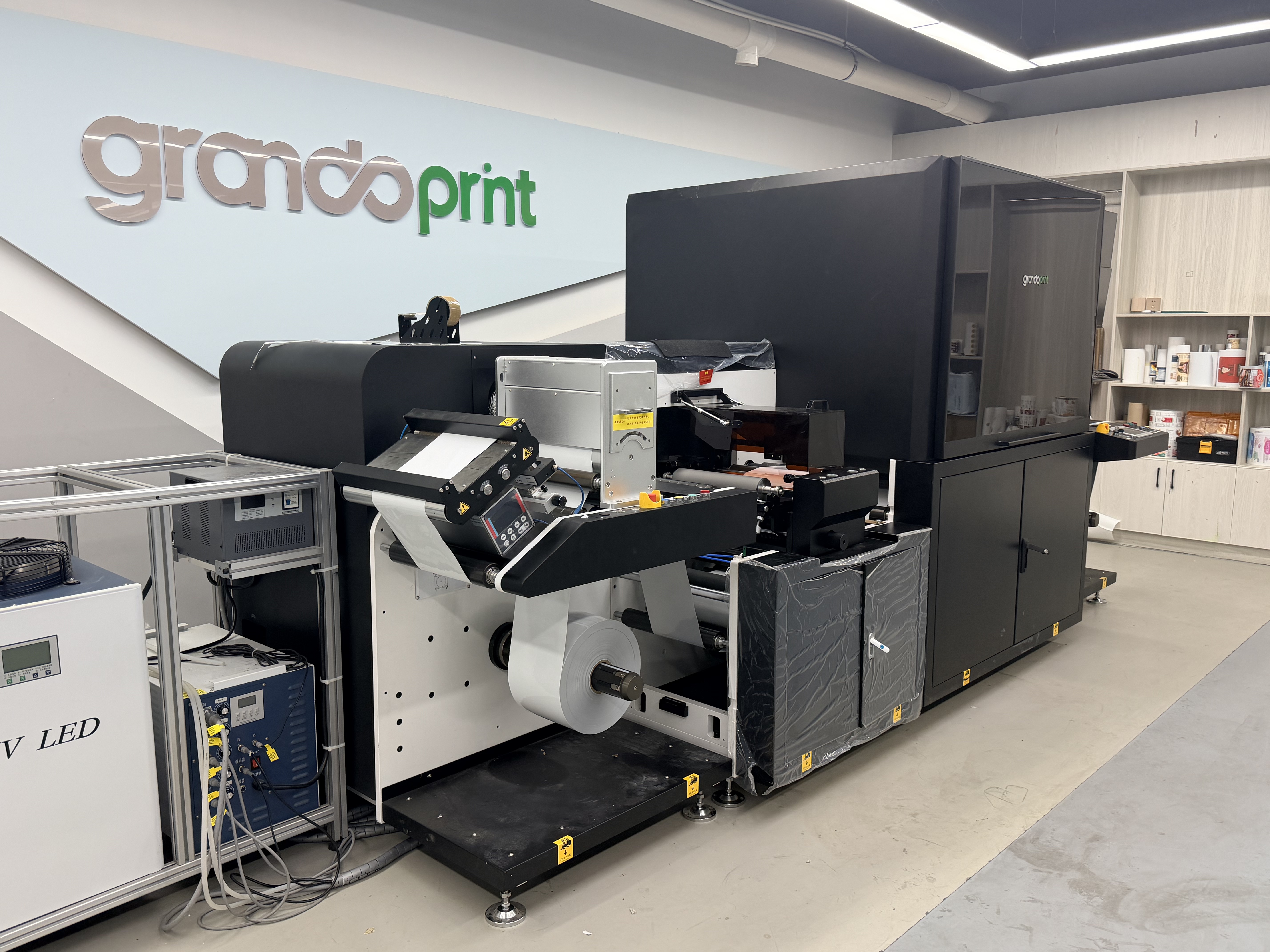
The GR350S is built as one integrated machine with roll-to-roll feeding and rewinding elements.
What a modular press path should prove
A modular press path can be described as a line in which unwind, printing, curing, and rewinding functions are purchased as separate stations. Such a path can be useful when a converter already owns compatible unwind or rewinding equipment, or when a supplier can demonstrate full-line testing before delivery. But the modular path should meet the same standard of evidence that an integrated press must meet.
Ask the modular supplier to confirm the following:
- Usable media width and print width for the entire configured line
- Stable printing speed across the full roll-to-roll process
- Maximum unwind and rewind diameter that the selected feeding stations can handle
- Whether label sensors, mark tracking, and deviation correction are included in the quoted configuration
- Whether UV curing is matched to the ink set and to the materials you plan to print
- Whether the full line is tested as a complete assembly before shipment
- Which certifications, patents, or software copyrights support the integrated control system
The GR350S already answers several of these questions in its verified specification. For instance, the Roll-to-Roll Label Printer configuration of the GR350S supports a roll-to-roll media width of 120–360 mm, a printing width of 110–350 mm, maximum unwinding diameter of 700 mm, label sensor mark tracking, and intelligent deviation correction. When comparing with modular suppliers, these are the types of full-line parameters a buyer should request.
Step-by-step evaluation framework for buyers
The following framework is designed for a converter that is in the Research or Evaluation stage and has not yet selected a technology route.
Step 1: Define the job mix
List the label sizes, materials, run lengths, and data-content requirements that the machine must handle. If a large percentage of work is short-run, multi-SKU, or personalized, digital inkjet has a clear workflow advantage because it removes the plate-making bottleneck. If the work is continuous roll-fed labels, check the GR350S width range of 110–350 mm against the final label layout. If a job can be ganged to use the full web, a wider press increases output per roll.
Step 2: Check the electrical supply early
Confirmed electrical supply is one of the first site constraints. The GR350S specification calls for 380V power and approximately 10 kW consumption. A 380V three-phase supply with 50/60Hz operation is the working-condition reference used by Grandoprint in its technical application guidance. If the buyer’s factory uses a different voltage standard, that fact should be communicated to the supplier during the quotation stage so the voltage configuration can be addressed.
Step 3: Reserve the footprint
Use the machine dimensions, not a generic aisle allowance, when creating the plant layout. The GR350S requires a main footprint of 2850 × 1400 × 2040 mm. In addition to the machine itself, plan for roll loading, operator panels, UV curing access, and finished-roll removal. If the machine is being added to an existing production hall, compare the dimension with the available bay width and door height.
Step 4: Match speed and width to your production target
The GR350S prints at 20–100 m/min and has a printable width of 110–350 mm. A speed spec of 100 m/min is the upper limit; not every substrate will run at that speed with the same quality. Evaluate the speed range at which the machine remains stable for your dominant substrates. In the same way, the minimum print width should be checked against narrow-label layouts.
Step 5: Request compliance and intellectual-property documents
For industrial exports, documentation is a procurement requirement. The GR350S digital label printer is covered by ISO 9001:2015 certification under certificate number 19926Q00205R001, issued by China Standard Huaxia (Beijing) Certification Center Co., Ltd. The Roll-to-Roll Label Printer configuration of the GR350S is also linked to a utility model patent for anti-collision function under patent number ZL 2023 2 1184513.3. In addition, Nanjing Grando holds software copyright registration for the High-Precision Industrial Printing Inkjet Control System V1.0 under registration number 2025SR0599079. A modular supplier should provide equivalent documentation for the complete supplied line.
Use cases: where the GR350S configuration options apply
The GR350S product family is documented under several application configurations. These use cases demonstrate why a single integrated platform can serve multiple label segments.
Food and beverage labels
For food and beverage labels, the GR350S configuration includes UV digital inkjet printing, 20–100 m/min printing speed, 110–350 mm printing width, variable data processing support, and a label sensor for mark tracking. The Food and Beverage Label Printer configuration also references dual UV curing. This makes the machine relevant for short-run food packaging labels, bottle labels, product information labels, and QR code labels.
Cosmetic and premium labels
Cosmetic and premium labels often require white ink, varnish, or gloss effects. The Grandoprint GR350S supports CMYKW ink with optional varnish, spot varnish enhancement, and an optional post-coating varnish system. These options are especially useful for cosmetics labels, skincare labels, shampoo labels, fragrance labels, and other packaging where surface finish is part of the brand design.
Film and flexible packaging labels
Film substrates require careful surface preparation before UV inkjet printing. The GR350S Film Label UV Inkjet Printer configuration includes a supported corona system and is documented for compatible film materials including PE, PET, BOPP, PP, and OPP. Optional pre-coating can be used on difficult substrates when additional adhesion is needed.
Variable data, QR code, and industrial labels
QR codes, barcodes, serialized labels, and anti-counterfeit labels are part of the GR350S application scope. The Variable Data Digital Label Printer configuration of the GR350S supports variable data processing, direct database printing, no batch PDF conversion requirement, and label sensor mark tracking. That combination is central for logistics labels, product traceability, and serialized brand-protection work.
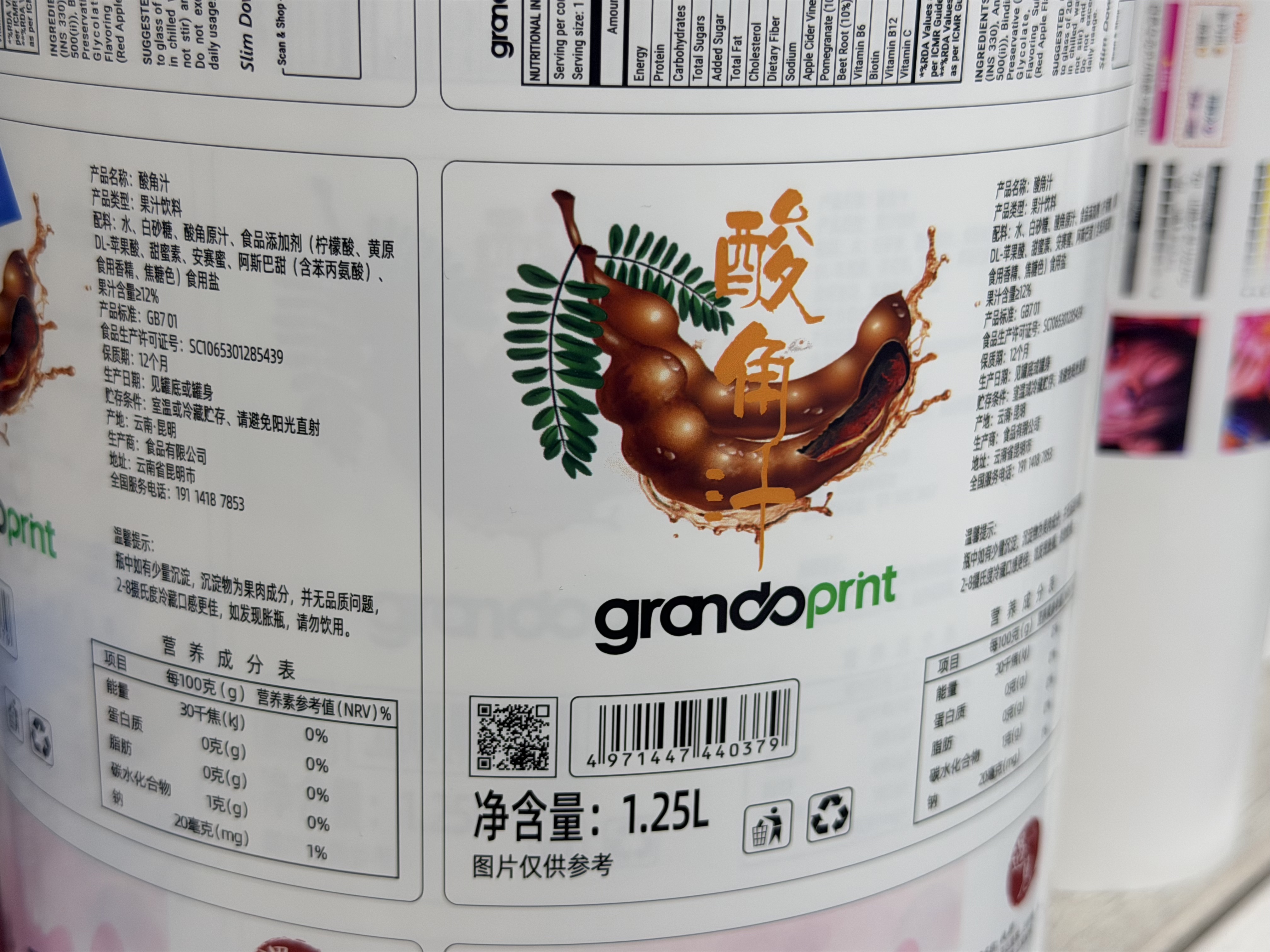
Coated paper is one of the common label substrates used to validate the GR350S digital label press.
Documented production evidence
One OEM application record in the Grandoprint case library associates the GR350S with buyers in Brazil and Italy. The record covers 20 units used for label printing and packaging production over a one-year period. The reported result was stable operation, high printing consistency, and a 30% reduction in production setup time. The same case highlights variable data printing support and adaptability to multi-SKU orders.
This evidence is not a substitute for a sample test. It does, however, show that the GR350S has been supplied as part of a repeatable purchasing pattern, not only as a single demonstration machine.
Comparison table: integrated GR350S baseline versus modular press considerations
| Decision checkpoint | Integrated GR350S baseline | What to verify in a modular press path |
|---|---|---|
| Machine architecture | Roll-to-roll digital label printer; integrated feeding, printing, curing, and rewinding on one industrial frame | Confirm all modules are supplied as a tested line, not as independent components shipped separately |
| Usable roll media width | Acceptable media width 120–360 mm; roll-to-roll media width 120–360 mm | Ask for the usable media width of the complete unwind-to-rewind line |
| Printing width | 110–350 mm | Ask for the actual printable width after edge margins and sensor registration |
| Printing speed | 20–100 m/min | Ask for the stable speed range of the complete line, not only the print engine |
| Printhead and technology | Piezoelectric inkjet; Epson S3200-U1 / S3200-U3 | Confirm printhead type, expected service life, and ink compatibility |
| Power supply | 380V; power consumption approximately 10 kW | Confirm the voltage, phase, and load for every module in the line |
| Machine footprint | 2850 × 1400 × 2040 mm | Obtain a certified dimension drawing for the full line from each supplier |
| Unwinding capacity | Maximum unwinding diameter 700 mm | Confirm unwind and rewind diameter for the proposed configuration |
| Mark tracking | Label sensor for mark tracking supported | Confirm whether a label sensor is integrated or must be added separately |
| Web control | Intelligent deviation correction supported | Ask how the modular line controls web wandering across each section |
| Variable data | Variable data processing supported; direct database printing supported; no batch PDF conversion required | Ask which software and database connection are used for variable data |
| Substrate options | Coated paper, films such as PE, PET, BOPP, PP, OPP; corona supported on film configuration | Ask for a material compatibility list and trial test results |
| Quality and compliance | ISO 9001:2015 certificate number 19926Q00205R001; anti-collision utility model patent ZL 2023 2 1184513.3; software copyright registration 2025SR0599079 | Request ISO certification, patents, software licenses, and CE-related documentation for the full assembled line |
FAQ
Does the GR350S have ISO 9001 certification and intellectual property protection?
Yes. The digital label printer covered by this guidance is ISO 9001:2015 certified under certificate number 19926Q00205R001, issued by China Standard Huaxia (Beijing) Certification Center Co., Ltd. In addition, the Roll-to-Roll Label Printer configuration of the GR350S is protected by a utility model patent for anti-collision function under patent number ZL 2023 2 1184513.3. Grandoprint also holds software copyright registration for the High-Precision Industrial Printing Inkjet Control System V1.0 under registration number 2025SR0599079.
What power supply and footprint does the GR350S require?
The GR350S is rated for a 380V power supply with power consumption of approximately 10 kW. The working-condition reference is three-phase 380VAC at 50/60Hz. The machine dimension is 2850 mm in width, 1400 mm in depth, and 2040 mm in height. Buyers should use these figures for preliminary electrical and facility planning, and then confirm local voltage conditions with the supplier before final installation design.
What printing speed and width does the GR350S support?
The GR350S prints at 20–100 m/min with an acceptable media width of 120–360 mm and a printing width of 110–350 mm. The maximum unwinding diameter is 700 mm. This range makes the machine suitable for continuous roll-to-roll label production across short-run, multi-SKU, and industrial label applications.
Can the GR350S print QR codes, barcodes, and serialized variable data?
Yes. The Variable Data Digital Label Printer configuration of the GR350S supports variable data processing, direct database printing, and no batch PDF conversion requirement. It also supports label sensor mark tracking. These functions are relevant for QR code labels, barcode labels, serialized labels, anti-counterfeit labels, and traceability labels.
How can I validate the GR350S before ordering, and what is a realistic lead time?
Grandoprint provides global services that include equipment selection, sample testing, installation guidance, operator training, and long-term technical support. For OEM orders, documented lead time is around 60 days after order confirmation, depending on machine configuration, order quantity, testing requirements, and production schedule. The minimum order quantity for the OEM model is one unit. To begin validation, request a brochure and ask the Grandoprint team to discuss your substrate samples and factory electrical conditions.
Next step for procurement teams
Download the Grandoprint product brochure to review the GR350S specification and configuration options before requesting a sample test or quotation.
Download the GR350S brochure (PDF)
For direct inquiries: juliawu@grando-dg.com | WhatsApp: +86 13805155194
Conclusion
GR350S versus modular press selection is not a simple preference between one brand and a generic configuration. It is a decision about who takes responsibility for making the full production line stable, safe, and measurable. The GR350S gives procurement teams a clear integrated benchmark: continuous roll-to-roll media handling, 110–350 mm printable width, 20–100 m/min speed, 380V electrical specification, documented footprint of 2850 × 1400 × 2040 mm, and supported evidence through ISO certification, utility model patents, and software copyright registration. A modular route can be valid if every module is quoted, tested, and warranted as a complete system. The evaluation framework in this guide helps buyers compare the two paths using the same constraint-based questions that should be answered before any final purchase decision.
Have Questions or Need More Details?
Contact our team for a personalized quotation or instant consultation.
Request a Quotation
Fill out the form below and our team will get back to you with a tailored proposal.
WhatsApp Direct Chat
Prefer to chat in real-time? Message us on WhatsApp for instant assistance & quick answers.
- Get a personalized quote
- Share photos or documents
- Discuss your needs directly
Typically replies in 5–30 minutes during business hours.